
Gotland Facts and Figures
Size, location, population, history and curiosities, the key facts about Gotland, Sweden's largest island, summarised and sourced.
Contents
Sweden's largest island
With a land area of around 2,994 square kilometres, Gotland is Sweden's largest island. Add Fårö and the smaller islands of the historical province and the total comes to about 3,184 km², so the commonly cited figure of "around 3,000 km²" is accurate. The island sits in the middle of the Baltic Sea, around 90 kilometres off the Swedish mainland coast, and forms its own county (län) and municipality.
At the end of 2025, the Gotland region had a population of around 60,000 (provisional SCB figures; 2024 saw 61,023). About half live in the island's only town, Visby, the rest are spread across villages and farms across the island. For how to get there, see the getting there guide and the ferry guide.
History: from the Hanseatic League to Sweden
From the 12th to the 14th century, Visby was the leading Hanseatic League centre in the Baltic; the 1161 Treaty of Artlenburg is regarded as a starting point of the Hanse. This golden age produced the town wall, built in the 13th century, and more than 200 warehouses and merchants' houses. Visby is considered the best-preserved fortified trading town in Northern Europe and has been a UNESCO World Heritage Site since 1995.
Decline set in during the 14th century. On 27 July 1361, the army of the Danish king Valdemar IV Atterdag crushed the Gotlandic peasant militia outside Visby's walls; around 1,800 dead were buried in mass graves at Korsbetningen, and the town surrendered two days later. Plague around 1350 and the Danish conquest ended Visby's leading role, in 1470 the Hanse stripped the town of its Hanseatic status. Gotland then belonged to Denmark for almost 300 years (in 1525 Lübeck bombarded the town wall). Only with the Peace of Brömsebro in 1645 did the island pass to Sweden, and it has remained Swedish ever since.
Island of a hundred churches
Gotland carries the nickname "island of a hundred churches", and with good reason: the island has 92 well-preserved medieval rural churches, most dating from the 12th to the 14th century, Romanesque and Gothic in style. The large majority of these rural parish churches remain in use today
- a density of churches found nowhere else.
In Visby itself the picture is reversed: of the medieval church stock, only Visby Cathedral (St Mary's) remains in use, while all the town's other churches are ruins. Gotland has 19 known church ruins in total, twelve to thirteen of them in Visby alone, the "Ecclesia Desolata", the abandoned churches of the former Hanseatic town. For more on their history and how to visit, see the churches guide.
Raukar: limestone stacks from a tropical prehistoric sea
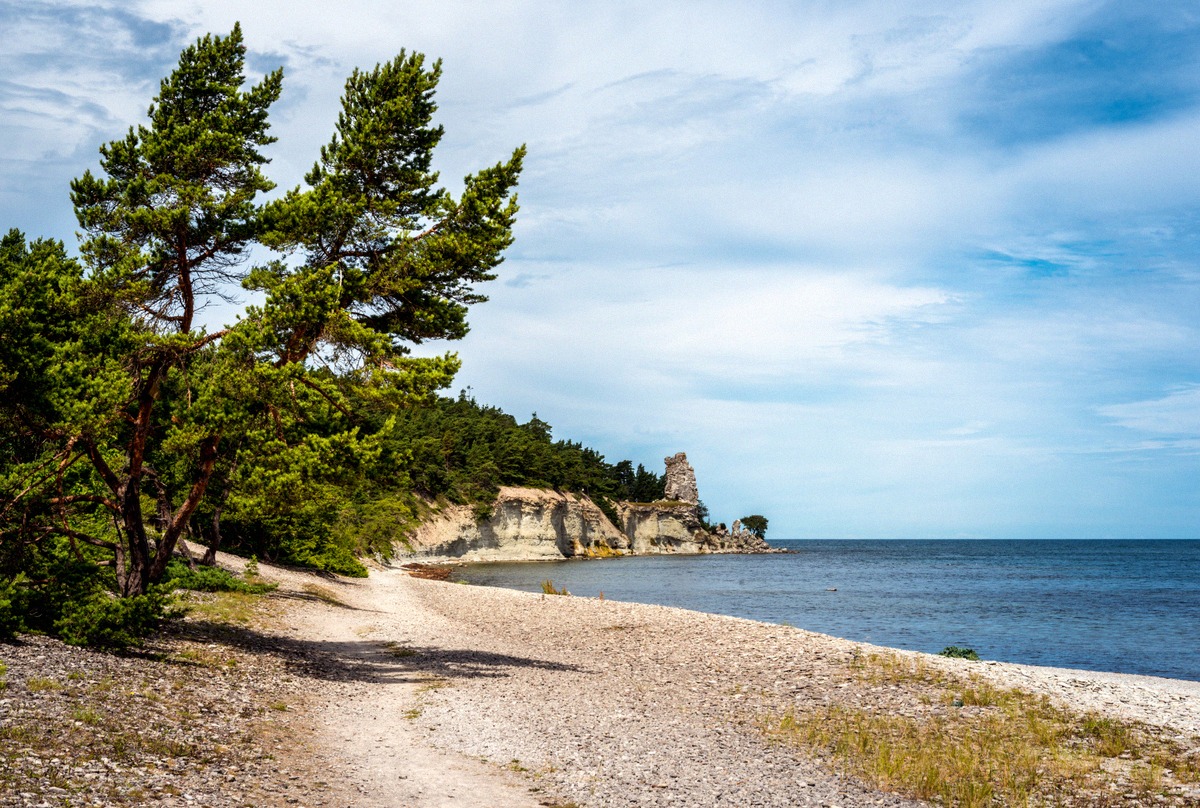
Gotland's most striking natural landmark is the raukar, free-standing limestone sea stacks along the coast. The rock is Silurian reef limestone formed from stromatoporoids and corals, laid down around 420 million years ago in a tropical shallow sea. The stacks seen today were shaped by surf and weathering after the last ice age.
The best-known sites lie in northwest Fårö and along Gotland's east coast:
- Langhammars and Digerhuvud in northwest Fårö - Langhammars alone has around 50 raukar, some more than 8 metres tall.
- Lergrav, Kyllaj and Holmhällar on Gotland's east coast.
- "Jungfrun" near Lickershamn, arguably the island's most famous single stack.
There is no total count of all the raukar on the island; only individual fields have been counted. More in the raukar guide and the overview of Gotland's nature.
Gotland sheep and Gotland pony
Two animal breeds shape the island's landscape and carry Gotland's name around the world.
The Gotland sheep (Gotlandsfår, a pelt sheep) was developed in the 1920s and 1930s by crossing the native Gute sheep with Karakul and Romanov stock. It is hornless, with a black, wool-free head and black legs, and its fleece is grey, ranging from silver to almost black. Ewes weigh around 55 to 70 kg and rams 75 to 85 kg; the breed is raised as a dual-purpose animal for pelt and wool as well as meat. Sweden holds the world's largest populations, with flocks on Gotland of up to 600 ewes; the breed is now also found as far afield as the United Kingdom, New Zealand, Australia and, since 2003, the United States.
The Gotland pony (Gotlandsruss) is Sweden's only native pony breed and a very old one, evidence traces it back to prehistoric times. The animals stand around 117 to 132 cm at the withers and weigh about 250 kg; duns, bays, chestnuts and blacks are common colours. The breed came close to extinction: around 1880 some 11,500 animals still roamed the island's heaths, but by 1930 only about 30 breeding mares remained. Today there are again roughly 6,000 to 8,000 Gotland ponies worldwide, most of them in Sweden. Both breeds can be seen grazing across the island.
Truffles and saffron: culinary rarities
The island's mild, sunny climate and limestone soil produce specialities rarely found elsewhere in Sweden. Alongside a few spots on Öland, Gotland is the only place in Sweden where truffles grow. It is the Burgundy truffle (Tuber uncinatum, an autumn truffle), which grows underground, preferring hazel and oak woodland on limestone soil, both wild and cultivated. The season runs from early October to around mid-December, or until the ground frosts; in autumn the Gotlands Tryffelförening organises truffle hunts and an annual truffle festival with tastings.
Saffron is likewise grown in only a handful of places in Sweden, Gotland among them. The sunny climate and limestone soil provide good growing conditions; the saffron goes into the saffranspannkaka, a Gotland saffron pancake and island speciality. For farms, season and addresses, see the food and drink guide.
Location, climate and best time to visit
Gotland's climate is strongly shaped by the Baltic Sea, which makes the island milder, sunnier and windier than mainland Sweden. In July the average temperature is around 17.5°C (daytime highs around 20°C), and in January around 0°C (roughly −2 to +2°C). Gotland is one of Sweden's sunniest regions, with around 2,000 to 2,100 hours of sunshine a year; in summer up to 10 to 11 hours of sunshine a day are possible.
The best time to visit is summer (June to August), with the warmest and sunniest weather. May and September are milder, quieter shoulder months for anyone wanting to avoid the peak-summer crowds; winter is mild but windy. A full month-by-month breakdown is in the guide to the best time to visit.