
Raukar - Gotland's Limestone Sea Stacks
Raukar are Gotland's iconic limestone sea stacks. Where the best fields are - Langhammars, Digerhuvud, Folhammar, Holmhällar, and how to visit them.
Contents
Stone sentinels from ancient reefs
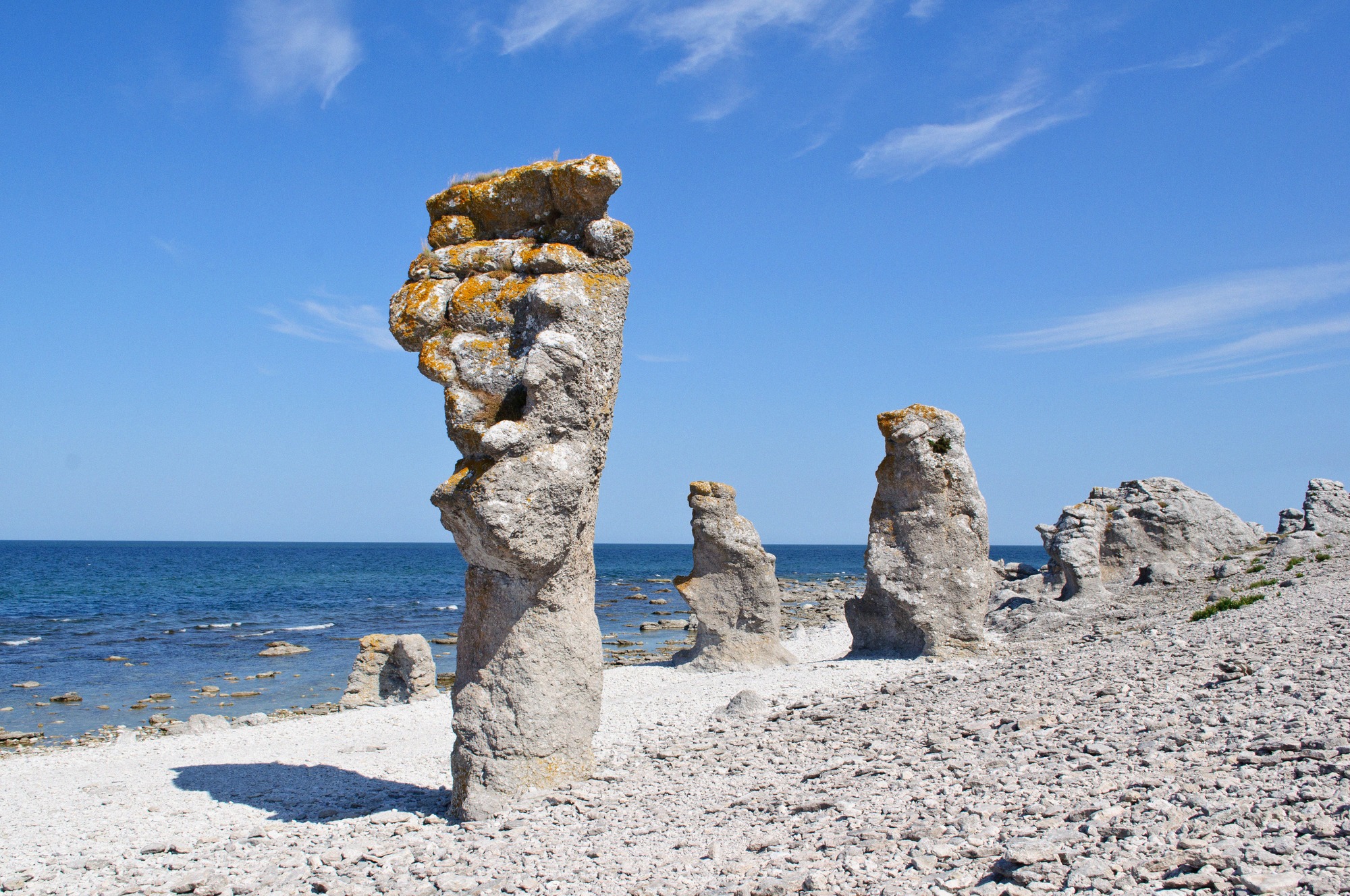
The raukar are Gotland's natural landmark: pillar-shaped formations of hard limestone standing along the coast like petrified figures. They formed from the remains of ancient coral reefs. Over a very long time the sea wore away the softer rock around them, while the more resistant reef bodies stayed standing, as pillars, arches and towers. The word rauk comes from the island's Gutnish dialect.
Many raukar have names because their outlines resemble something recognisable. The Hunden ("The Dog", also known as Kaffepannan or Sankt Oles port) near Gamla Hamn on Fårö looks like a dog gazing at the horizon; the Hoburgsgubben ("The Old Man of Hoburg") stands watch at the island's southern tip, and the Jungfrun ("The Maiden") rises near Lickershamn. Heights vary considerably: most raukar measure from a few metres up to around eight to ten metres, with a handful taller still. At around twelve metres, the Jungfrun is Gotland's tallest single rauk, on its plateau it rises a total of about 27 metres above sea level.
Langhammars on Fårö, the most famous raukar
Langhammars, on the west coast of Fårö, is arguably the island's best-known raukar field. On the sloping shore above Klajvika stand around 50 raukar, some of them over eight metres tall. They're the most photographed raukar in Gotland and even feature on the back of the Swedish 200-krona banknote. One named formation with its own information board is the Guldstugan ("Golden Hut").
- Views and shoreline: The stacks can be taken in from a raised viewpoint or explored up close from the beach.
- On site: There's a free car park, an accessible toilet, picnic tables and a barbecue spot, bring your own firewood.
- Best atmosphere: Langhammars is considered one of the finest sunset spots on Fårö, when the warm light turns the pillars gold.
Digerhuvud - Sweden's largest raukar field
Also on Fårö's west coast is Digerhuvud - Sweden's largest raukar area. The field stretches for around 3.5 kilometres along the coast; the nature reserve covers 113 hectares and has been protected since 1930. The raukar here vary from just a few metres to around eight metres in height, lined up into a striking "sea of stone".
Despite its size, Digerhuvud is easy to reach: a paved road runs through the reserve, linking its different sections. There are several designated car parks - including at Lauterhorn and Helgumannen, plus picnic tables and toilets. Dogs must be kept on a lead, except between 1 November and 31 January. If you'd rather explore the field on foot, you'll find more on the paths in the hiking guide.
Folhammar near Ljugarn, raukar on the main island
Not every rauk stands on Fårö: the best-known field on the main island is Folhammar, on the east coast about two kilometres north of Ljugarn. Its central section is roughly 500 metres long and made up of numerous raukar up to six metres tall. The reserve has been protected since 1974 and covers 77 hectares. It's about a 15-minute walk from Ljugarn to the raukar field, and there's a car park right by the field itself.
Folhammar is the only one of these fields that's explicitly accessible: a paved path and adapted barbecue spots make it possible to visit with a pushchair or wheelchair. Geologically it's notable for its fossil-rich reef limestone, the rock contains mainly stromatoporoids (nicknamed "cat skulls" locally) as well as remains of sea lilies.
Holmhällar in the south, the quiet, sweeping field
At Gotland's southern tip, in the parish of Vamlingbo, lies Holmhällar, one of the island's largest raukar fields. It curves along the coast from Skvalpvik to the fishing hamlet of Holm, up to 40 metres wide and almost a kilometre long. The raukar here reach just under five metres in height. The reserve has been protected since 2008 and is considered an easy, quieter field to visit, often nearly deserted.
Near the Pensionat Holmhällar there's a car park with plenty of space, and nearby you'll find a sandy beach and a restaurant, more on Gotland's beaches in the swimming guide. About 600 metres offshore lies the island of Heligholmen, a Natura 2000 bird sanctuary where numerous species breed, including cormorant, barnacle goose, eider, herring gull, common and Arctic tern, oystercatcher and redshank.
Tips for your visit
All the raukar fields are freely and openly accessible under Sweden's right to roam (allemansrätt), including the car parks. Clear protection rules apply in the reserves, though, and you should stick to them:
- Don't damage or take anything: The rock formations must not be damaged, and stones or fossils must not be removed.
- Stay on the paths: Driving off the marked roads is prohibited; only light open fires at the designated barbecue spots.
- Wear sturdy shoes: The ground along the raukar coasts is stony and uneven.
- Take care when swimming: Swimming right next to the formations isn't recommended, as there can be underwater currents.
The best time for photos is the golden hour shortly after sunrise or before sunset, when the light turns the limestone pillars gold. For a visit, summer (June to August) brings the warmest weather; May and September are quieter with still-pleasant conditions. The most spectacular fields are on Fårö - good reason to combine your island trip with a day along the raukar coast. For how the raukar fit into the rest of the island's highlights and what else to know about Gotland's nature, see the linked guides.