
Swimming & Water Sports on Gotland
Water temperatures, the best beaches, kayaking, SUP and surfing, plus safety tips on currents and algae blooms. Gotland's swimming guide.
Contents
Swimming in the Baltic Sea, when the water is warm enough
Gotland, Sweden's largest island in the Baltic Sea, is one of the sunniest places in the country: Visby gets a good 2,000 hours of sunshine a year and has won Sweden's sunniest-summer competition eleven times since 1990. In July and August, Visby typically sees around eight to ten sunny days a month, with daytime highs of about 20 to 21°C.
Even so, the Baltic Sea takes its time to warm up. Around Gotland, surface water temperatures sit at only around 12 to 14°C in June, rise to about 17°C in July, and peak at around 18°C in August. August is therefore the warmest month for swimming, before the water cools back down to 12 to 14°C in September. The real swimming season is short and concentrated in July and August, see also best time to visit.
The best beaches for swimming
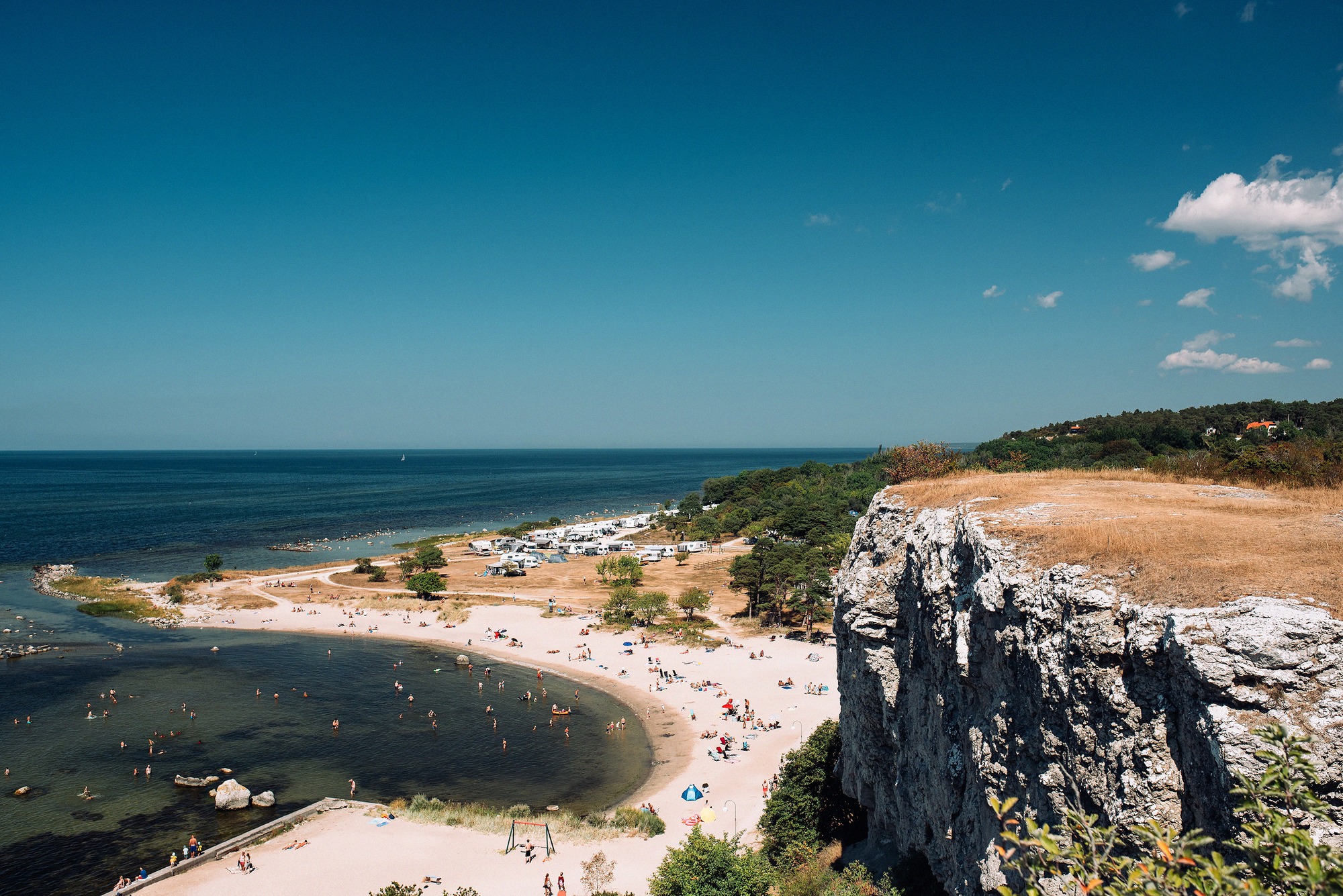
Gotland's coastline alternates between fine sand, shallow bays and the island's characteristic limestone cliffs (rauk formations). A full selection is covered in the beach guide; for swimming, these beaches stand out in particular:
- Tofta, near Visby: the island's most popular and best-equipped beach. It has toilets, restaurants, kiosks, a beach club, volleyball and padel courts, a pool and kayak hire; Tofta Camping sits right behind the beach. Tofta is also the only beach on Gotland with a lifeguard tower (in operation since 1995, staffed during weeks 28 to 31 of the peak summer). There are two main beach access points with paid parking, around 60 SEK per day in high season, paid via an app, with part of the fee funding the lifeguards.
- Sudersand on Fårö: one of Gotland's longest and finest sandy beaches, with a gently shelving shoreline. The Sudersand Resort provides toilets, restaurants, bars, cafés, shops, a playground, an outdoor gym, and tennis and padel courts. Parking is paid; overflow vehicles are directed to the car park by the campsite.
- Family beaches: Particularly shallow and child-friendly are Åminne (a long sandy beach with a restaurant, kiosk, pool and mini-golf), Norrlanda/Hammars (a bathing jetty and shallow sand) and Slite in the northeast. More in the Gotland with Kids guide.
Altogether, the Gotland region manages or co-manages 39 designated bathing spots; an official interactive web map shows them all. Water quality at each bathing spot can be checked via the Swedish Agency for Marine and Water Management (Havs- och vattenmyndigheten, "Badplatsen").
Kayaking & SUP
The coastline, with its bays and rauk formations, is ideal for paddling. Hire and guided tours are available all around the island, so you don't need your own boat:
- Self-service by app: Kayakomat runs self-service stations for single and double kayaks and SUP boards in Herrvik, Katthammarsvik and Slite. Bookings are unlocked by code, with life jackets and other gear included, available from two hours up to several days.
- West coast: ArcAdventure rents kayaks and SUP boards in Klintehamn (around 30 km south of Visby) and offers guided tours and kayak courses along the west coast.
- South: Vändburg Kajak, at the southern tip (Storsudret), offers hire, beginner courses (around 550 SEK for adults, 350 SEK for those aged 10 to 15) and guided tours, including a seal safari to the Raude Hund seal colony.
- Archipelago: Gotland Active runs guided tours, including for beginners, mostly in the Slite archipelago.
- Non-profit option: With Friluftsfrämjandet Gotland, a kayak on a guided tour costs around 200 SEK for members, while a private tour for non-members costs around 350 SEK per day and kayak.
Exact hourly rates and opening times vary by season, it's best to check and book with the operator in advance.
Snorkelling & diving
At several spots the water is clear enough to explore the Baltic's shallow underwater world. Well-known spots include:
- Snäck, near Visby, rocky seabed and clear water.
- Smöjen, a flooded limestone quarry where you can spot perch and crayfish.
- Ekeviken on Fårö, clear, shallow and rocky.
- Holmhällar, on the south coast, where rauk formations reach right down to the shoreline.
- Blå Lagunen, near Ire, a former limestone quarry with crystal-clear, wind-sheltered water.
Visibility depends heavily on wind and weather; there are no official visibility readings or fixed species lists for these spots.
Surfing, windsurfing & kitesurfing
For wind and water sports, Tofta is the island's best-known spot: southerly and northwesterly winds blow side-shore across the wide bay, creating a beach break where the first roughly 80 metres are shallow enough to stand. Outside the main swimming season, Tofta is considered a good kitesurfing spot. Surflogiet in Tofta offers surf lessons, glamping and a beach restaurant.
The best wind season runs from May to June, with a reliable sea breeze; July and August are calmer but sunnier, while the autumn storms bring wind and good waves back. There are no reliable figures on typical wind strengths, anyone planning to surf or kite is best off checking the current forecast shortly before heading out.
Swimming safely: currents, wind and algae blooms
Gotland's waters are mostly calm, but a few things are worth keeping in mind:
- Currents and wind: in offshore winds, inflatable floats can drift out to sea; in onshore winds, rip currents often form in the middle of bays. The Swedish Sea Rescue Society (Svenska Livräddningssällskapet) Gotland has more detailed advice.
- Algae blooms: in summer, cyanobacteria blooms (algblomning) regularly occur around Gotland. The region takes water samples at 23 public bathing spots. When algae blooms are dense, don't swim, they are toxic if swallowed and can irritate the skin; children, pets and livestock in particular need to be kept away. Alternatives are beaches with offshore winds, or the flooded limestone-quarry lakes.
- Nature protection: several stretches of coast have access restrictions during the breeding season. Ugnen (in the south, from Hammarudd to Snoderviken) and Heligholmen (south of Holmhällar) are both closed from 15 March to 30 June, and the Närsholmen nature reserve from 15 March to 15 July. More in the nature guide.
To check current conditions, use the Gotland region's interactive bathing-spot map and Havs- och vattenmyndigheten's Badplatsen tool, the Naturkartan app is also handy for routes and hikes on foot. For tips on getting around, see the Gotland travel information guide.