
Gotland Travel Information
Best time to visit, getting there by ferry or flight, getting around, money, emergency numbers and key contacts, the practical basics for a first trip to Gotland in 2026.
Contents
Gotland sits in the middle of the Baltic Sea, reachable only by ferry or plane, and runs on different rhythms from mainland Sweden: a pronounced summer season, a thin bus network, its own calendar of events. This overview answers the questions that come up before a trip, when to go, how to get there, how to get around once you're there, and what to know about money and your phone. Each section links to a fuller guide for more depth.
Best time to visit
Gotland is very much a summer island. July and August are the warmest months, with daytime highs usually around 20 degrees, the most pleasant stretch, but also the busiest and most expensive, when every museum, restaurant and ferry runs at full tilt. June already brings very long, bright days: around 19 hours of daylight and roughly 11 hours of sunshine, with highs of 18 to 19 degrees and nights around 10 degrees.
- May and September: cooler, with daytime temperatures around 12 to 16 degrees, but sunny and noticeably quieter, ideal for walking and cycling without the crowds.
- Swimming: the Baltic only reaches around 14 to 18 degrees in summer. Because the sea is warmest in late summer and early autumn, September often still works well for a swim, the payoff of the quiet low season.
- Winter: the island turns much quieter and many attractions close for the season. Visby's medieval Christmas market brings its own particular charm during Advent (more on that below).
For exact climate figures and month-by-month comparisons, see the weather guide.
Getting there: ferry or flight
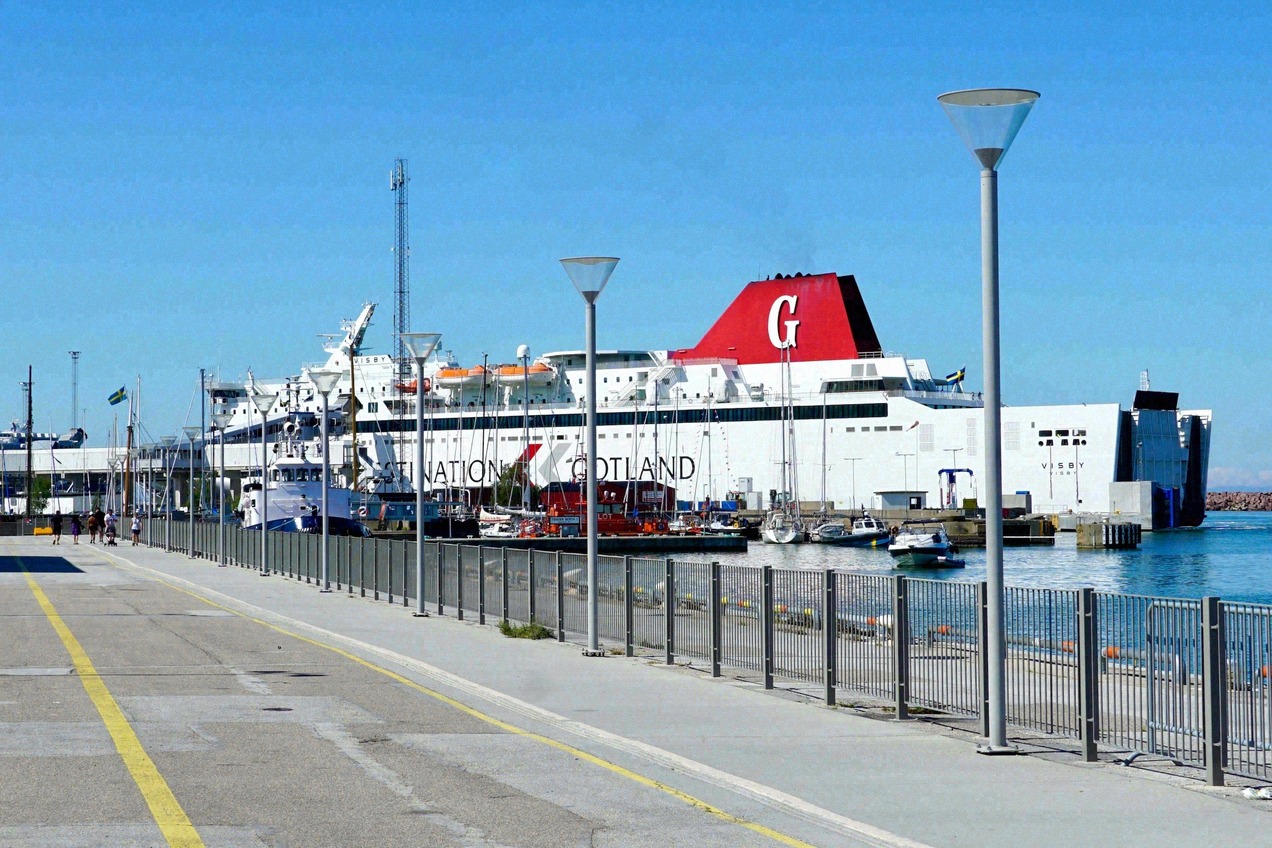
Gotland can only be reached by sea or by air. Destination Gotland runs two ferry routes to Visby:
- Nynäshamn-Visby: year-round, three to four departures a day, crossing time around 3 hours 15 minutes. Nynäshamn is south of Stockholm.
- Oskarshamn-Visby: two to three departures a day, crossing time around 3 hours.
Ticket prices are dynamic. For a single adult ticket in 2026, the price cap (takpris) is 436 SEK, averaging around 327 SEK; cheaper Minibiljett fares start from around 231 SEK per person depending on demand, mainly in the low season from September to May. A car is carried for an extra charge on top: package fares including a car (around five people plus a car or camper van under six metres) start from roughly 1,250 SEK one-way, rising to 1,350-1,500 SEK for larger vehicles.
Flying is quicker via Visby Airport (VBY): Stockholm to Visby takes only about 40 minutes. In 2026, SAS and Norwegian fly non-stop from Stockholm-Arlanda, alongside Finnair, FlexFlight and Air Alsie; the key routes are Stockholm, Copenhagen and Gothenburg, and from June 2026 SAS also launches a new direct route from Gothenburg. Fares from Stockholm are often around 100-150 US dollars in the low season and considerably higher in the summer peak, booking around two months ahead tends to bring the price down. Details are in the getting there guide, the ferry guide and the flights guide.
Getting around the island
Visby itself is easily walkable; once you want to explore beyond it, you need a plan.
- Car hire: the most flexible option. Pick-up points are at the airport, the harbour and in town. Car hire prices in Sweden range from around €20 a day (low season, small car) to €80 a day (peak season, large car); reckon on €40-50 a day in August, with summer rates running up to 50 percent above winter ones. Book early for the peak season. More in the car hire guide.
- Fuel: petrol in Sweden costs around 17.50 to 20 SEK per litre in 2026 (roughly €1.40-1.50 for 98 octane), generally a little cheaper than in many other European countries.
- Bus: Region Gotland runs a local bus network from Visby bus station, including routes 10/11 Visby-Hemse (some via Roma) and route 20 Visby-Fårösund, which connects with the Fårö ferry. The regular timetable runs from 17 August 2025 to 13 June 2026. Buses are infrequent out in the countryside, though, so they don't suit spontaneous day trips well.
- Bicycle: Gotland is flat, with plenty of quiet roads and cycle paths. A relaxed option for day trips and shorter distances; more in the cycling guide.
Money, language and staying connected
Sweden uses the Swedish krona (SEK). Like the rest of Sweden, Gotland is almost entirely cashless: card payment is accepted practically everywhere, and many places no longer take cash at all. Bring a widely accepted credit or debit card, you'll rarely need cash. When paying by card, check that the transaction is charged in kronor rather than converted to your home currency on the spot, to avoid unfavourable exchange rates.
The official language is Swedish, but English is spoken very well almost everywhere, so getting by as a visitor is straightforward. Within the EU, roam like at home rules have applied since 2017: with an EU mobile contract you can call and browse on Gotland without roaming charges. (Travellers from outside the EU should check their own tariff before arriving.)
Events and booking ahead
Gotland's event calendar has a big effect on how busy things get, if you're coming for a major event, book well ahead:
- Almedalen Week (Almedalsveckan): a political and public-debate forum in Visby, running Monday to Friday, 22 to 26 June in 2026.
- Medieval Week (Medeltidsveckan): the largest event of its kind in northern Europe, with around 500 programme items, running 2 to 9 August in 2026, mostly in Visby. The island is especially fully booked during this week, more in the Medieval Week guide.
- Christmas in Visby: the best-known highlight is the medieval Christmas event "Medeltida Jul" in the St Nicolai ruins, with torchlit processions, knights in armour and Gotlandic crafts, plus a Julmarknad on Stora Torget over several Advent weekends.
As a rule for the summer months of June to August: book early. Ferries have limited vehicle capacity, and accommodation fills up fast, especially at weekends, on public holidays and during major events. Outside the season, availability is usually easy to find. More dates are listed in the events guide.
Contact and key addresses
The main point of contact on the island is the tourist information office in Visby (Gotlands Turistbyrå), near the harbour and old town. It has maps, brochures and advice, and can book tours and tickets; opening hours are longest during the summer season (June-August). Online, three addresses matter most:
- gotland.com, the island's official tourism site, covering attractions, accommodation, events and getting there (available in English among other languages).
- destinationgotland.se, the ferry operator for crossings to Visby (timetables and tickets).
- visitsweden.com - Sweden's official tourism portal.
In an emergency, Swedish numbers apply: 112 is the European emergency number (police, fire, ambulance, and sea rescue) for any acute emergency; 1177 is 24-hour medical advice ("Vårdguiden"), also available in English; 114 14 is the police non-emergency line. Emergency call handlers speak Swedish and usually English too. The island's hospital is Visby lasarett in Visby, with an emergency department, call 1177 first for non-life-threatening issues, and 112 for acute emergencies. Pharmacies ("Apotek") are found in Visby and the larger towns. Bring your European Health Insurance Card (EHIC) or GHIC if travelling from the UK, or take out travel insurance, and note down the key numbers and the name of where you're staying.
There's no consulate on Gotland itself; the relevant office for most visitors is your own country's embassy in Stockholm.
Good to know
- Gotland is its own Swedish province; its biggest town and only place with full infrastructure is Visby, whose old town is a UNESCO World Heritage Site.
- The island has its own distinctive wildlife: the hardy Gotland sheep (whose wool and pelts are a signature island product) and the small Gotland pony (Gotlandsruss). Wild ponies can be seen at Lojsta hed, Sweden's only Russ reserve: around 80 animals graze freely across roughly 650 hectares, some pastures are open to the public, and guided walks run in summer.
- The small neighbouring island of Fårö to the north is reached by a free ferry and makes a worthwhile day trip.
- For more on the island's history, geography and key figures, see the Gotland facts guide.