
Cycling on Gotland
Gotland is flat and ideal for cycling: the 540 km Gotlandsleden, great day routes from Visby, bike hire, best time to visit and island touring tips.
Contents
Why Gotland is a cycling island
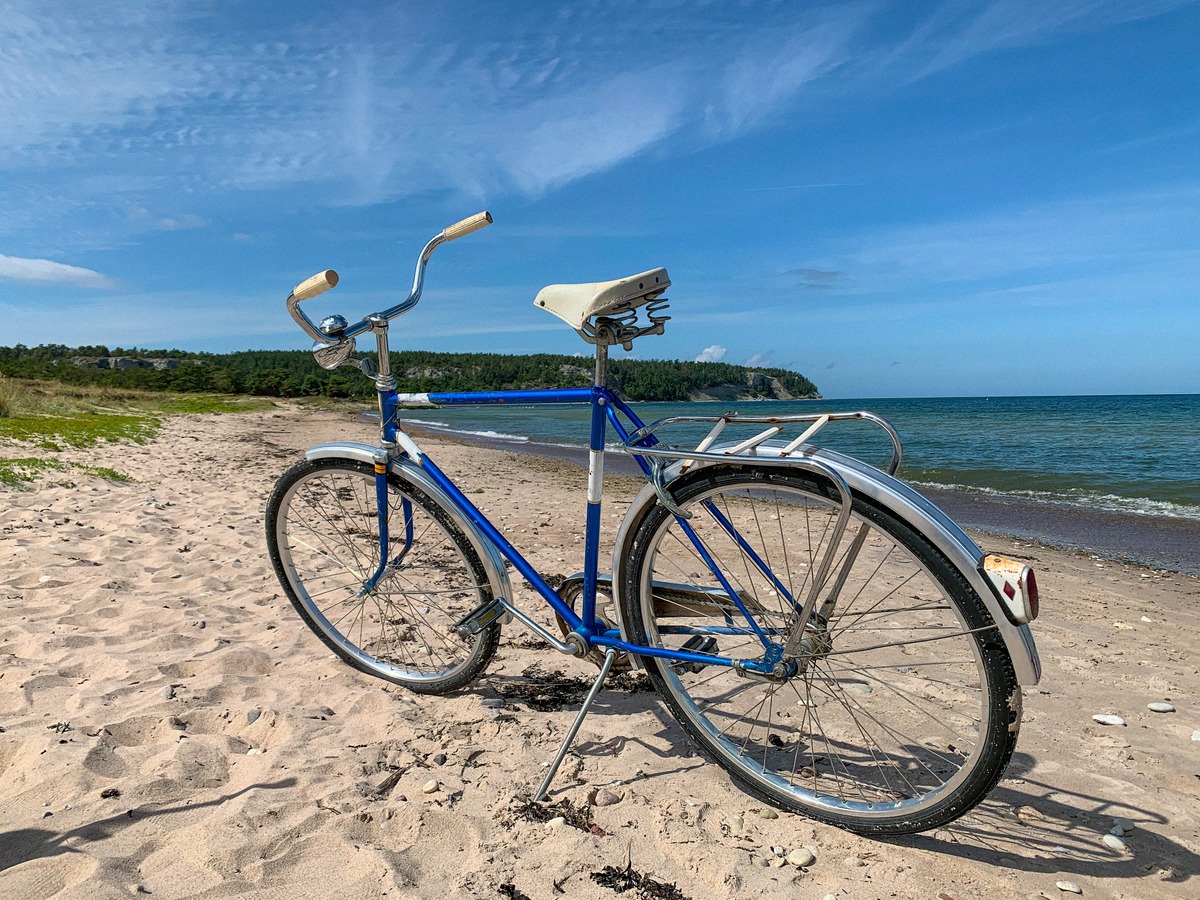
Gotland is mostly flat, the country roads are quiet, and distances stay manageable. Instead of any real climbs, you get coastal stretches, pine forest, fields, fishing villages and, time and again, one of the medieval countryside churches. Just how flat the island really is shows in the highest point along the round-the-island route: Lojsta hed, at a mere 82 metres above sea level.
It's exactly this topography that makes cycling here manageable for almost anyone. The round-the-island route is officially rated beginner-friendly and suits families and e-bike riders too. If you like it sporty, you can ride it as an intense weekend challenge; if you'd rather take it easy, spread it gently over a week with stops for food and overnight stays along the way.
The Gotlandsleden: a full loop of the island
The backbone of cycling around the island is the Gotlandsleden, a continuously signposted cycle route of around 540 kilometres in total that loops the whole island. You'll recognise it by the red "Gotlandsleden" signs. Worth knowing: only about 16 kilometres of that is dedicated, car-free cycle path, by far the greater part runs on small, quiet country roads. The surface is a mix of asphalt and gravel.
The route splits into two main sections:
- Södra Gotlandsleden (south): around 337 km, and with roughly 1,560 metres of elevation gain on its own, the tougher of the two halves.
- Norra Gotlandsleden (north): around 292 km.
Total elevation gain for the complete loop is given as around 1,520 metres, very moderate spread over hundreds of kilometres. Depending on which variants and shortcuts you choose, a full loop of the island works out at somewhere between about 300 and 500 kilometres. You don't have to ride the Leden in one go, though: individual stages make good day trips, most conveniently picked up from Visby.
Great day rides from Visby
For day trips, the well-developed cycle paths around the capital are the obvious choice. Unlike the largely road-based Leden, some of these stretches are car-free:
- Visby - Tofta (west coast): the loop towards Tofta beach, roughly via Södra Hällarna, Högklint and Ygne, there and back, runs around 40 kilometres and hugs the coastline along the water. A continuous coastal cycle path north from Visby has existed here since 2014.
- Visby heading north (Road 149): along Road 149 there's a car-free cycle path from Visby to Lummelunda, the obvious direction if you plan to continue on to Fårösund and the Fårö ferry later. Distance and terrain depend on how far you ride.
- Visby heading south (Road 140): there's also a dedicated, car-free cycle path along Road 140 from Visby to Klintehamn, a relaxed way to get out of town without much traffic.
A particularly worthwhile stretch for nature lovers is on the east coast near Ljugarn. About a kilometre northeast of the village, the coastal path takes you easily by bike to the Folhammar nature reserve, with its roughly 500-metre-long field of sea stacks (the raukar here reach up to six metres tall). Admission is free; the reserve is largely accessible, with a firm surface path, toilet, car park and a barbecue and picnic area.
Bike hire in Visby
Most hire outlets are based in Visby, and some offer island-wide delivery, but don't expect fixed stations of their own in smaller places like Tofta or Ljugarn. Three key operators:
- Gotlands Cykeluthyrning (GCU): Skeppsbron 2 (621 57 Visby), right by the ferry terminal. Over 800 bikes, city, trekking, e-bikes and MTB - from 140 SEK a day, phone +46 498-21 41 33. During peak summer weeks 27 to 32, GCU delivers and collects bikes anywhere in Visby and on Gotland (Fårö excepted).
- Visby Hyrcykel: two central stations, at Österport (Österväg 1, near the bus station and the city wall) and at the harbour (Färjeleden 14, at the ferry terminal). The season starts on 8 June, with island-wide service included, phone +46 498-25 66 10.
- rentbike.se: also at Skeppsbron 2, with hybrid and e-bikes, cargo bikes, tandems and MTB. Open Mon-Sun 09:00 to 18:00, online advance booking available.
Exact daily rates, especially for e-bikes, usually only appear in the online booking form; budget a bit above GCU's "from 140 SEK" headline figure. According to its own website, GCU's 2026 opening hours in Visby are: 11-21 June daily 09:00-16:00, 22 June-16 August daily 09:00-18:00, 17-30 August daily 09:00-16:00, 31 August-30 September daily 09:00-14:00; from October, by email enquiry only.
Worth knowing for high season: bikes are then often booked out by the week. Early online booking is recommended, and it needs to be made by the day before at the latest. If you bring your own bike, you can take it on the ferry to Visby.
Cycling to Fårö
The northern neighbouring island of Fårö is superb cycling territory, and getting there couldn't be simpler. The Fårö ferry between Fårösund and Broa covers just 1,300 metres, the crossing takes around six minutes, and as part of the public road network it's free, cyclists included. During the day it runs roughly every 30 minutes; in summer it runs without booking from 04:30 to 01:30, sometimes every 10 to 15 minutes. One exception concerns hire bikes: island-wide delivery doesn't extend to Fårö, you'll need to cover that last stretch on your own bike, or one hired in Visby.
Best time to go, and the wind
Gotland has a mild, sunny but windy Baltic climate, and on a bike, the wind is often more of a factor than any climb. Across the year, May is the calmest month on average at around 16.6 km/h, while December is the windiest at about 25.2 km/h. June brings the longest days (around 18 hours of daylight) and the most sunshine (about 12 hours a day), ideal for long stages.
The driest stretch of the year runs from March to July; even July, the wettest month by rainfall total, has only around 13 rainy days. Across the year, Gotland gets around 530 mm of rainfall and about 2,100 hours of sunshine. In practical terms for a cycling trip, that means early summer and early autumn are a good compromise between mild, dry weather and manageable crowds.
That's because peak season is July, and Visby is at its busiest during Almedalsveckan (week 27) and Medeltidsveckan (week 32). Accommodation and bike hire are often booked solid in those weeks. If you're travelling then, secure a bike and a place to stay well ahead; more on climate and timing is in the weather guide. On the open coast, wind and sun protection belong in your luggage regardless.
Practicalities for a multi-day tour
Along the Gotlandsleden, the route breaks down comfortably into day stages with somewhere to stay and eat. Accommodation options are varied: campsites, cabins (stugor), hostels (vandrarhem), hotels, and farm stays on former farmsteads, some close to the sandy beaches. There's no fixed, ready-made stage plan with named accommodation, it's best to plan your own split based on how you're feeling and the distance you want to cover. For ideas on where to stay, see the camping guide.
For orientation, free official cycling maps are available as PDFs on the official tourism website gotland.com, including a dedicated Gotlandsleden map. Sweden by Bike additionally offers GPX downloads for members and a printed map (around 159 SEK). Before you go, it's also worth a look at the activities and family guides if you want to combine cycling with other things to do on the island.