
The Churches of Gotland
Gotland has 92 medieval churches built before 1350, a uniquely dense ensemble by European standards. What makes the island of churches special.
Contents
The island of a hundred churches
Few things shape Gotland's landscape as much as its churches. Scattered across the whole island stand 92 medieval churches built before 1350, one of them is the cathedral in Visby, while the remaining 91 or so are rural parish churches in the villages. Add to that a handful of ruined "ödekyrka" - abandoned churches such as Ardre/Gunnfjauns kapell, Bara, Elinghem and Gann. No other part of Sweden has so many medieval churches packed into such a small area, which is why the nickname "the island of a hundred churches" is barely an exaggeration.
Most of the churches were built between the 12th century and the mid-14th century. More than a hundred churches and chapels were begun before 1350, with craftsmen from Germany among those working on them. Building activity largely stopped after around 1350: the Danish conquest of 1361 and the Hanseatic League's growing dominance brought economic decline. Because there was little money left afterwards for rebuilding or modernising, the churches have survived largely in their original medieval state - which is exactly what makes this ensemble unique in Europe.
Why so many churches were built here
The wealth behind the church building came from long-distance trade. In the 12th and 13th centuries, Gotland's farmers, known as the Gutar, grew rich on trade across the Baltic - Russian and Finnish furs, and beeswax from the Baltic states. The Gotlanders even ran their own trading post in Novgorod, the Gotenhof, and Visby was the hinge point between the Baltic and Western Europe. Only towards the end of the 13th century did German Hanseatic merchants increasingly take over the business.
With this money, parishes built their stone churches, almost every village had its own. Contrary to popular belief, amber trade was not the main source of wealth, but rather the broad range of goods moving along the early Hanseatic trade routes. When trade collapsed in the 14th century, the money for further new building and later modernisation dried up, and it is precisely that standstill which preserved the medieval heritage.
What makes the rural churches so special
The roughly 91 rural churches are not just numerous, but also exceptionally complete in their furnishings. Their medieval interiors, font, pews, side altars, poor boxes, rood crosses, choir stalls, altarpieces, tabernacles and piscinas, have largely survived in their original spatial arrangement, mostly dating from between 1150 and 1350. Art historians consider these ensembles unique, since comparable interiors have almost entirely been lost elsewhere. Garde kyrka, with its churchyard, ranks among Sweden's best-preserved medieval church ensembles.
Two features are particularly typical of the island:
- Stained glass: Gotland's churches hold the best-preserved medieval stained glass in Northern Europe. Around 90 per cent of all surviving medieval stained glass in Northern Europe comes from Gotland's churches, mostly from the 12th and 13th centuries; it can be seen in around thirty rural churches.
- Baptismal fonts: Gotland's fonts were carved in Romanesque workshops that art historians group by style into schools such as Hegwaldr, Majestatis, Byzantios and Sigrafr. Early pieces are sandstone, later ones limestone. From the 12th century onwards, these workshops exported fonts across the entire Baltic region, more than 1,500 exported fonts have been documented, and their distribution closely mirrors the Hanseatic trade routes.
Add to that Gothic portals, limewash murals and defensive towers. Which church has the "finest" windows or the most striking font is a matter of taste, but on almost any drive through the countryside, a spontaneous stop is worthwhile.
Worthwhile stops in the countryside
A good starting point is the abbey ruin at Roma in the centre of the island. The Cistercian abbey was founded in 1163/1164 by monks from Nydala, on the very site of the Gotlandic thing assembly. It is considered one of Sweden's best-preserved early medieval monastic sites; the grounds of Roma Kungsgård are freely accessible with information boards, and double as an open-air theatre stage in summer. Notably, the portal of Roma's abbey church became the model for church portals across the whole of Gotland - Cistercian influence shaped the island's stone architecture at large.
In the north, Lärbro church is worth seeing for its unusual octagonal west tower (dendrochronologically dated to the 1340s; the upper section was rebuilt in 1522 after storm damage). Next to it stands a kastal, a 12th-century defensive tower, of the many kastal towers Gotland once had, only three survive: in Gammelgarn, as the powder tower in Visby's town wall, and here in Lärbro. Also worth a look in the north is the church at Bunge.
In the south, Öja kyrka is a highlight: its oldest parts date from the early 13th century, and it holds the only standing monumental rood cross left in Northern Europe, a Gothic work by the "Öja Master," a French-trained wood carver active in the late 13th century. Alongside it stands the "Öja Madonna" (a Mater Dolorosa) and well-preserved limewash murals from the 12th and 14th centuries. Other art-historically important rural churches include Dalhem, Endre, Lye, Stånga and Rone.
The churches of Visby
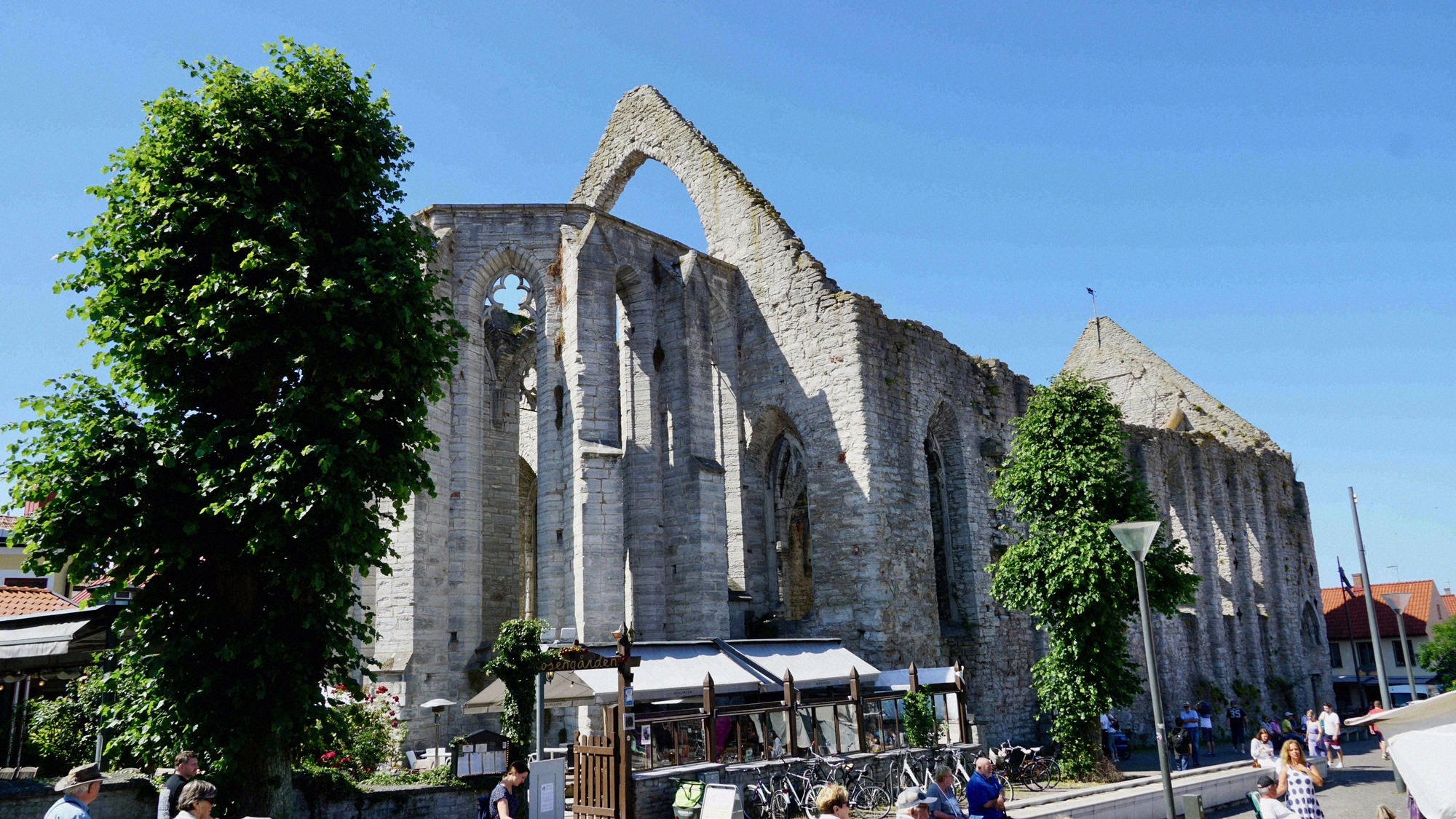
In Visby itself, the island's church history shows a different side: around 13 church ruins from the Hanseatic era stand here, and only a single medieval church is still in use - Visby Cathedral (S:ta Maria). The ruins include S:t Nicolai, Drotten, S:t Lars, S:t Hans, S:ta Karin, S:t Olof, Helge And, S:t Clemens, S:ta Gertrud and S:t Per.
Several of these ruins are open in summer (May to September), including S:t Olof, S:t Lars, Drotten and S:ta Karin. Many can also be hired for events, among them Drotten, Helge And, S:t Clemens, S:ta Gertrud, S:ta Karin, S:t Lars, S:t Nicolai and S:t Per; during Medieval Week they become atmospheric event venues. From October to April, a key for the ruins can be borrowed from Gotlands Museum for anyone wanting to see them outside the season. More on the Hanseatic town and its town wall is in the Visby guide.
Visiting, opening hours and getting there
Gotland's rural churches are active parish churches, hosting services, weddings, christenings, concerts and talks. Quiet, respectful behaviour applies inside accordingly. They are generally open to visitors during the day in summer, officially from mid-May to mid-September (often given as 15 May to 15 September). Outside this season, roughly October to April, access varies by parish, and some churches can only be opened by arrangement with a key. There is no reliable figure for how many churches stay open year-round, so anyone visiting outside summer should plan for locked doors. An admission fee is not usual; the churches are free to enter.
The easiest way to reach most rural churches is by car or bicycle along the quiet country roads. A full loop of the island, "Gotland Runt," is an established, largely flat cycle route of around 209 kilometres, linking sea stacks (raukar), medieval churches and limestone coastline; there is also the waymarked Gotlandsleden, covering around 500 kilometres in stages. Southern Gotland in particular suits relaxed rides with short church and village stops. That the density is manageable was shown by one Gotland resident who cycled to all roughly one hundred medieval churches in 2020. There is no fixed "church loop" with a set distance or number of churches, a few well-chosen stops along the way achieve more than a rush across the whole island. Which churches fit into a bigger day's itinerary is covered by the attractions overview; general practical information is in the travel information guide.